
CLAUDE COWORK PLUGIN
Stop Launching Blind.
The Synthetic Audience Lab runs any piece of copy through a scored, data-validated focus group... and returns a Resonance Score before you ever hit send.
One-time payment · Lifetime access · 30-day guarantee
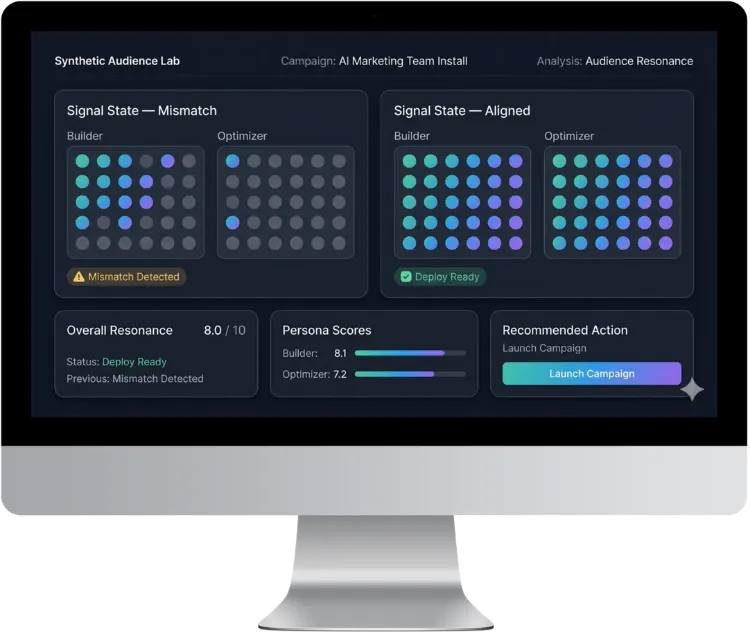
The Gap That's Costing You More Than You Think
You write good copy. You send it. And you find out if it worked after it's already in front of 8,000 people.
You know exactly how this goes.
You write the email. You craft the headline. You approve the draft. You hit send...
...and then you wait.
Refreshing the dashboard. Watching the open rate climb or stall. Finding out, after it's live, whether the copy actually worked.
That gap between "I think this is good" and "I know this will land" is where revenue disappears. Not in dramatic crashes.
In sequences that convert at 1.8% instead of 3.4%...
In offer pages that underperform by 20% for no obvious reason...
In emails that get opens but no clicks because the CTA didn't match what the buyer was actually asking...
At $49 each, that's $6,272 left on the table. From a single send. Before you knew there was a problem.
Most marketers close this gap the same way: a gut check, a colleague who says "looks good to me," and whatever worked last time.
The problem is that gut has no methodology. Your colleague doesn't speak for your buyer. And "what worked last time" is a sample size of one.
But... what if you had a score (not a feeling) before you launched?
What if you could put any piece of copy... an email, a headline, a landing page section, an ad... in front of a structured focus group and get a quantitative score back in minutes?
Not a vibe. Not "it sounds good." A number backed by real customer psychology data, cross-referenced against 15 years of DM member language, and broken down by buyer type so you know exactly which segment isn't buying and why.
That's what the Synthetic Audience Lab does.
INTRODUCING
Synthetic Audience Lab
"This is not a 'what do you think?' tool. This is a measurement instrument."
The Synthetic Audience Lab is a Claude Cowork plugin that turns any marketing copy into a structured focus group session.
Three synthetic personas — built from real DigitalMarketer member psychology and 15 years of customer language data — read your copy, react from their distinct psychological operating systems, and get scored across four critical dimensions.
The result is a quantitative Resonance Score and three prioritized optimization pivots you can act on immediately.
THE PROTOCOL
The 8-Step Focus Group Protocol
Every time you run /experiment [your copy], the Lab executes a complete, disciplined sequence:
1
Ingestion
Parses your copy's format, primary promise, audience signal, and funnel stage.
2
Focus Group Reactions
Each persona reacts in 150 words, first person, present tense — authentic psychological response from their distinct operating system.
3
Cross-Examination
Each persona identifies the exact line that made them want to buy or leave. The precision here is what separates this from generic AI feedback.
4
VoC Validation
Findings cross-referenced against embedded Voice of Customer libraries drawn from real member intake data. Every reaction is grounded in documented buyer language — not inference. Matches are flagged [VoC-MATCHED. Inferences are flagged [ASSUMPTION].
5
Resonance Score Report
A scored table with R_total across all four dimensions and all three personas. You get a number, not a feeling.
6
Gap Analysis
Flags Positioning Mismatches when the spread between personas exceeds 2.5 points. A wide gap means your copy is working for one segment and failing another — and you need to know before launch, not after.
7
Optimization Directives
Three specific Copywriter Pivots — not vague advice, but precise edits with expected score lift attached.
8
Auto-Log (v0.2.0)
The full report saves automatically to your Audience Lab Results folder, timestamped and formatted for searchability. Every test builds your library.
THE SCORING ENGINE
Four Questions Every Buyer Is Really Asking
No matter who your audience is or what you're selling, every piece of copy gets evaluated through the same four mental filters. A weakness in any one of them is enough to kill a conversion.
Leverage
"Is the result worth the effort?"
Does the offer promise meaningful outcomes without demanding disproportionate time, money, or effort? Buyers operating at scale evaluate this first. If the value-to-effort ratio isn't obvious, they move on.
Predictability
"Will this actually work?"
Does the copy make the result feel certain and step-by-step, or vague and dependent on the buyer figuring things out on their own? High-ticket buyers in particular need to believe the outcome is reliable, not aspirational.
Cognitive Ease
"Do I know what to do with this?"
Is the copy effortless to read and act on? Buyers who have to work to understand your offer don't buy it. Confusion is a conversion killer at every price point.
Strategy over Hype
"Is this real, or is this hype?"
Does the copy hold up under scrutiny, or does it substitute bold claims for substance? Experienced buyers destroy copy that doesn't pass this test.
Each dimension is weighted based on how strongly it correlates with conversion behavior. The four scores combine into a single Resonance Score (R_total)... a number you can act on.
SCORING BENCHMARKS
What Your Score Means
Every /experiment run returns an R_total. Here's how to read it.
| R_total | Status | What It Means | Action |
|---|---|---|---|
| 8.5 – 10.0 | Deploy-Ready | Strong across all personas | Launch as-is or with minor polish |
| 7.0 – 8.4 | Strong with Gaps | One or two dimensions pulling it down | Apply 1–2 targeted pivots |
| 5.5 – 6.9 | Mixed Signal | Personas splitting — someone is not buying | Split test or ICP-specific rewrite |
| 4.0 – 5.4 | Weak Signal | Fundamental messaging problem | Return to Core Message Canvas |
| Below 4.0 | Do Not Deploy | Full disconnect from audience reality | Full rewrite required |
THE ENGINE
The Lab Scores Against Your Buyers, Not a Generic Audience
The Lab's scoring engine is built to simulate how real, specific buyers think. To run it, you configure it with your own audience personas: the distinct buyer types who actually purchase your offers, defined by their revenue context, primary buying question, and psychological bias profile.
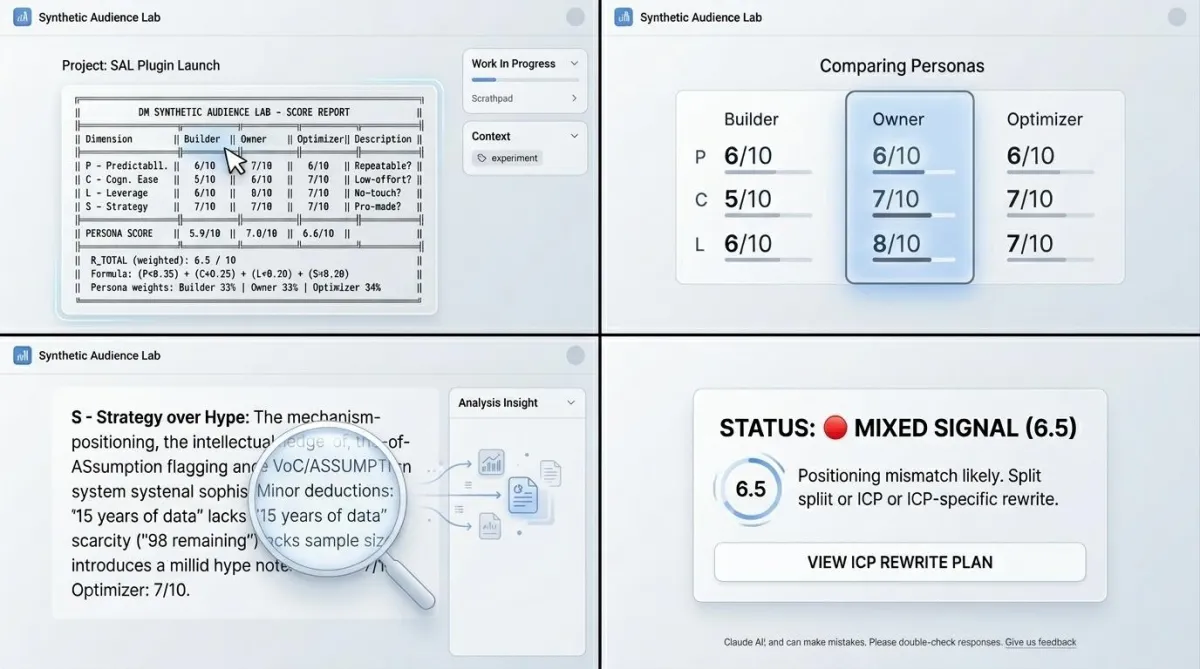
Each persona you define gets its own Voice of Customer library — real language your buyers use, pulled from reviews, surveys, and intake conversations. The Lab cross-references every reaction it generates against that library. Matches are flagged [VoC-MATCHED]. Inferences are flagged [ASSUMPTION]. No dimension scores above 7/10 without real buyer language backing it up.
What this means in practice: the Lab doesn't tell you "this sounds good." It tells you which buyer type is hesitating, on which dimension, and gives you the exact language to fix it. The output is auditable. You can see precisely where the score came from and why — which matters when you're making copy decisions across a team or at scale.
Example: What a configured Lab looks like
Below is an example of three personas built for a marketing training audience. Three distinct buyer segments at different revenue stages, each with a different primary buying question.
Persona A — The Builder
Entry-level buyer · $0–$5K/mo
"Do I know exactly what to do Monday morning?"
Primary bias: Cognitive Ease + Predictability
Persona B — The Owner
Mid-market buyer · $10K–$50K/mo
"Does this give me my weekends back?"
Primary bias: Leverage + Cognitive Ease
Persona C — The Optimizer
High-revenue buyer · $50K+/mo
"Can I run $100K/mo through this without it breaking?"
Primary bias: Predictability + Strategy
You build the personas that match your market. The Lab provides the engine, the 8-step scoring protocol, and the validation framework. Once you've defined your audience, every /experiment run scores copy against how your specific buyers actually think.
TEST WHAT YOU'RE ACTUALLY SELLING
Score Against the Buyer Who Actually Matters for This Offer
Default weights are equal across all three personas. But most offers aren't targeted equally, a $27 entry offer speaks primarily to a different buyer than a $5,000 retainer. The /weight command lets you rebalance before a test so your score reflects the audience that actually matters for this specific piece of copy.
| Test Type | Recommended Weight Profile |
|---|---|
| Entry offer ($27 – $97) | Entry persona 60% / Mid persona 30% / High-ticket persona 10% |
| Mid-ticket ($297 – $997) | Entry persona 25% / Mid persona 55% / High-ticket persona 20% |
| High-ticket service ($5K+) | Entry persona 10% / Mid persona 30% / High-ticket persona 60% |
| Broad market / awareness copy | Equal (default — 33% / 33% / 34%) |
Example: /weight PersonaA:70 → then /experiment [your entry-level offer copy]. Your score now reflects how the buyers most likely to purchase actually respond, not a blended average that dilutes your signal.
PROOF OF CONCEPT
We Tested Our Own Offer With It. Here's What Happened.
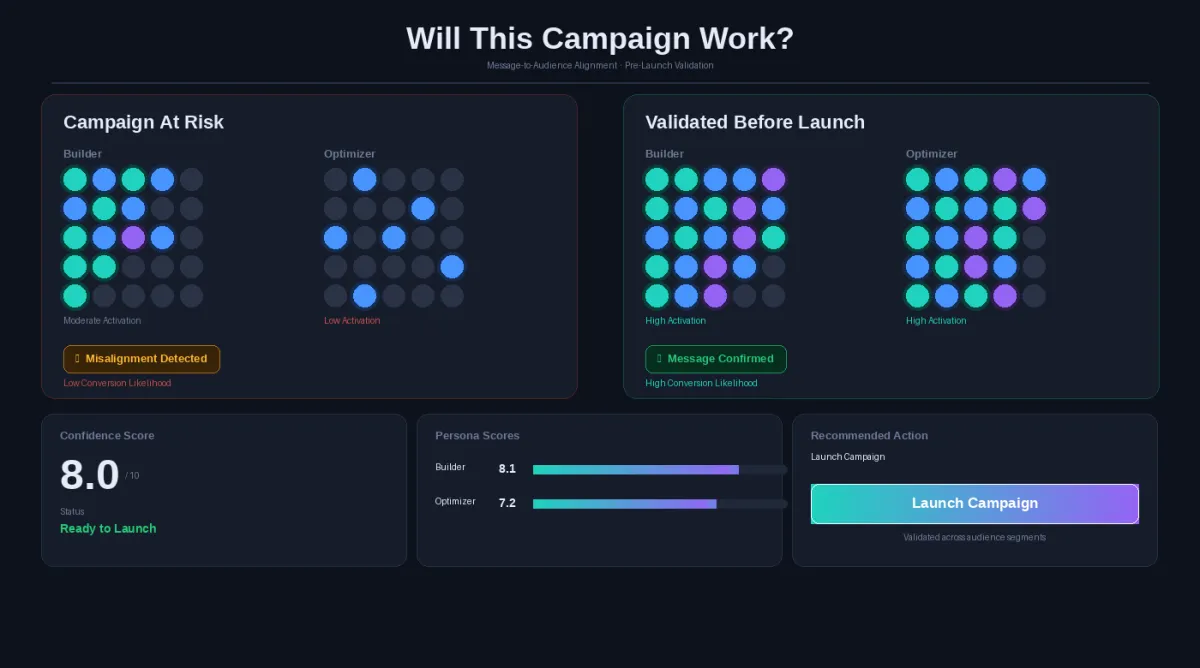
6.4 → 8.0
The Synthetic Audience Lab isn't a theory. Before we launched the AI Marketing Team Install Pack (our last plugin release), we ran the offer copy through the Lab.
The initial score came back at 6.4. Mixed Signal.
The Lab flagged one positioning mismatch: the Owner persona wanted more specificity on time-to-value. It surfaced three pivots. We applied two of them and ran the page again.
Revised score: 8.0. Deploy-Ready.
The page converted above our historical benchmark on day one. We had a score prediction before we had a result, and the result confirmed the score.
The AI Marketing Team Install Pack sold out.
We're not claiming the Lab caused the sellout. We are saying the Lab correctly identified the offer as strong before we knew the outcome, and its diagnosis matched what buyers actually responded to in the launch.
When an instrument predicts performance before the fact and the outcome confirms it, that's validation. Not coincidence.
On methodology and reproducibility
The scoring protocol is disciplined and consistent: the same 8 steps, the same four dimensions, the same VoC cross-referencing on every single run.
The [VoC-MATCHED] / [ASSUMPTION] flagging system is built specifically so you can audit the output: you can see exactly which reactions are grounded in real buyer language and which are inferred. That auditability is what makes the scores trustworthy at scale.
Repeated runs on identical copy produce scores within ±0.3 points. That's tight enough to make score changes after pivots meaningful, not noise. When you apply two Lab-recommended pivots and the score moves 1.2 points, that's a real signal, not variance.
That stability is what makes the Lab usable as a measurement instrument rather than just a feedback generator.
AUTO-LOGGING
Every Test Builds a Library You'll Actually Use
Version 0.2.0 added automatic result logging. After every /experiment run, the full report is silently saved to an Audience Lab Results folder in your workspace. Timestamped, formatted, searchable.
Files are named YYYY-MM-DD_[descriptor].md and include a quick-reference header with R_total, per-persona scores, and positioning flag.
Six months of consistent use and you won't be starting from zero on every campaign. You'll have a searchable history of every copy decision you've made... what scored high, what got flagged, what pivots you applied, and how scores shifted after changes.
Most teams at your scale don't have this. After a few months with the Lab, you will. That compounding asset is worth more than any individual test.
What You're Installing
Everything Inside the Lab
Command
/experiment [copy]
Run any piece of copy through the full 8-step focus group protocol. Unlimited runs. Every result auto-logged to your Audience Lab Results folder.
Command
/weight [adjustments]
Rebalance persona weights before a targeted test. Match the score to the segment that actually matters for this specific offer.
What you bring. What the Lab provides.
You Bring
What you know about your buyer... their biggest frustration and their primary buying question
~10 quotes from your reviews or DMs... enough to run your first scored experiment
Lab Provides
The scoring engine and Resonance Formula
The 8-step focus group protocol
VoC validation framework
Optimization directive system
BUILT TO OPERATE
Set a threshold. Hand off the command. Review what gets flagged.
Once your personas are configured, anyone on your team can run /experiment. You don't review every draft. You review flagged scores.
Set your deployment threshold (say, 7.0) and hand the command to whoever owns copy. Anything above the threshold is cleared to launch. Anything below it, or anything that flags a Positioning Mismatch, comes to you.
You step in surgically, not constantly. The Lab becomes the quality filter between first draft and send, without you being the bottleneck.
Running lean or solo? The Lab is most useful here. You write the email at 10pm. You run /experiment. If the score comes back 7.1, you send it. If it comes back 5.8 and flags a Cognitive Ease gap, you fix one sentence and run it again.
No colleague to ask. No second-guessing. Just a number that tells you whether to send or not... in under three minutes.
One Offer · One Price · 100 Installs
$495
One-time payment · Lifetime access · No subscriptions
✓ Full Synthetic Audience Lab plugin for Claude Cowork — install in minutes, runs immediately
✓ /experiment command — run any copy through the full 8-step focus group protocol, unlimited
✓ /weight command — rebalance persona weights to match the segment you're actually targeting
✓ Scoring engine, Resonance Formula, VoC validation framework, and optimization directive system
✓ Automatic experiment logging — every run saves a full timestamped report to your Audience Lab Results folder
✓ Lifetime access — all future updates included
One-time payment | Lifetime access | 30-day guarantee
Limited to 100 installs — spots going fast
The 30-Day Guarantee
Install the Synthetic Audience Lab. Configure your personas. Run your first experiment. If the report doesn't change a single copy decision you were about to make, email us inside 30 days and we'll refund every cent.
We make that guarantee confidently because the system is designed to produce a result every single time you run it. If you do the setup, it works. That's not a marketing line. That's how the protocol is built.
Questions
Before You Install
Is this just AI making stuff up?
No, and the way the Lab is designed makes the difference visible. When you configure your personas, you include real VoC language: actual quotes and phrases from your buyers pulled from surveys, reviews, and conversations. The Lab cross-references every reaction it generates against that library.
Matches are flagged [VoC-MATCHED]. Anything the model infers without a direct match is flagged [ASSUMPTION]. No dimension scores above 7/10 without buyer language backing it up. The methodology is transparent and auditable inside every report.
What kinds of copy can I test?
Anything. Email subject lines, email body copy, ad headlines, ad body, landing page sections, sales page copy, VSL scripts, SMS — any marketing text meant to persuade a specific buyer. The Lab parses the format and funnel stage automatically.
How is this different from asking Claude to review my copy?
A generic "review my copy" prompt returns opinions without structure. The Lab runs a disciplined 8-step protocol: standardized persona simulations, cross-examination, VoC validation, a quantitative score formula, gap analysis, and three specific pivots with expected lift. You get a number, not a vibe — and every score is reproducible.
Do I need to set up personas before I can use it?
Yes, and here's what that actually looks like.
You answer three questions about your buyer: What stage of business are they in? What's the #1 question they're asking before they buy? And what do they actually say when they describe their problem? Then you pull 10 real quotes from your reviews, testimonials, or DMs — the exact words your buyers use when they talk about their situation.
That's it. First persona takes about an hour. After that, every /experiment run is instant.
Do I need Claude Cowork for this?
Yes. The Synthetic Audience Lab is a Claude Cowork plugin and requires an active Claude Cowork session to run. If you're already using Cowork, install is immediate — click, install, done.
What happens after 100 installs?
The offer closes. We cap installs to manage onboarding quality and deliver a consistent experience. When 100 is 100, it's done. There's no waitlist and no guarantee of a future release at this price.
Your next promo is already written.
The only question is whether you launch it blind or launch it scored.
100 installs · One-time · Lifetime access
Limited to 100 installs: 72 remaining